Showing posts with label Ideas. Show all posts

Thursday, January 18, 2007

Adventures in Craigslist Furniture Ads

In the spirit of yesterday's guide to furnishing your first home on the cheap (without loss of style or comfort), I've plunged in to the world of the Philadelphia section of Craigslist to dig up some examples.


Here are this week's great finds, along with tips on updating.


1. 1890's Sofa Table. This sofa table is a (relative) bargain at $125, looks very sturdy and could be used as a makeshift dining area, bed stand or side table. The leather upholstery (on the table top) seems to be well-weathered and doesn't require any updating. The finish itself isn't terrible, but I would personally spray paint the entire piece in a cream color. Maybe robin's egg blue. As you can see, the beauty of the piece is in the shape of the legs and the general proportion. A solid paint color will highlight those aspects.

2. Chaise Lounge, $375 A bit pricey for our general purposes (furnishing a home for not a lot of money), but not so bad when you consider that Baker is selling a similar one for $2,000+. I personally find chaise lounges to be entirely necessary to my very being, so if I were so inclined, I'd buy this, then re-upholster in a turquoise or raspberry linen, then painting over the wood in gold, white or black (if with raspberry).


3. 1950's Blonde Oak Dresser, $65 Slightly hotel-esque, but sand down that oily sheen, replace the knobs and paint really any color you wish. I'd advise spray paint specifically made for furniture, available at Home Depot/Lowe's. Could also be used as a sideboard.

Wednesday, January 17, 2007

Starting Out: How to Furnish Your Home, Cheaply and Stylishly

I'm always hesitant to pick up any of the effusive books/magazine articles that promise to let you in on the secrets to decorating your home cheaply and stylishly. Why? Because the tips are usually ridiculous--written by the sort of person who finds bliss in suggesting $300 towels, are far craftier than the general population (Make a lamp out of an old vodka bottle!) or are putting cheapness at a higher priority over quality.

It IS possible to furnish your home on a slight budget without sacrificing quality, style or even comfort. I know because I've managed to do it over the course of a year and a half, right down to the collection of 14 platinum-edged porcelain dinner plates ($3.50-$7.99 a piece) that I bought last week.

So get your piggy banks, here are the secrets to charm on the cheap, even if you're just starting out in your own hovel of an apartment:

1. Develop an eye for quality and style. Browse the high-end magazines for furniture ads or general setting photos. You're not doing this to follow trends, you're just honing your ability to spot high quality and expensive-looking styles. If you study, you'll be able to go to most secondhand stores (read: not vintage, not overpriced nonsense) and come out with something that looks antique. Or will at least know how to re-work a questionable item so it does look special.

2. Start saving--you'll need about $1,500-2,000 at most for this step. Winter (specifically January) and Summer (usually August) are the best times to buy high-ticket furniture for insane discounts. Really. I just bought a $3800 hand-carved table for an insane price. I have bought dresses for more than this table. Waiting for clearance sales=great payoffs.

3. Paint your rooms, if needed. As much as I hate saying this, do a neutral color. I know, I have coral pink walls, but if you're just starting out, it's hard enough buying furniture without having to worry about it matching a silver-and-watermelon-pink wallcovering. Pale buttercream, grey with the slightest twinge of pink, and regular cream are always flattering. Extend the paint on to the ceiling if you can for a more-finished look.

4.. Where to invest. Learn to live with the couch (or upholstered chairs) and dining room table you presently have. These two furniture pieces make a HUGE difference on your overall decor, you have no idea. Even if you fill your home with priceless curiousities, a cheap futon will ruin everything. Same goes for cheap tables with thick layers of plastic-looking veneer. Invest modestly in these two pieces. You will always use a couch and a nice big table. You can even use the table as desk, if you're pressed for space.

If you own a very tiny space--meaning no possible room for a dining room table--replace your counters and/or cabinetry. Huge difference.

In the meantime, get rid of your cheapest-looking, dreary stuff. If it can't be painted to look better, give it away.

5. Almost always, buy these items on sale at high-end places: Plates, drinking glasses and goblets, blankets/bedding, end/accent tables, decorate storage, pillows, drapes, rugs and tablecloths. Buy more plates and glasses than you think you need.

5.a. Usually buy solids, unless you see a pattern you adore. Make sure the curtains you buy aren't see through.

6. Almost always, buy these things second-hand, looking for the highest quality possible: Coffee tables, chairs, bureaus, headboards, mirrors, tall cabinets (instead of bookshelves or wall-mounted cabinets). Look for classic lines, good detailing and convincingly good construction. Don't worry about color or hardware--these can be replaced.

6.a. Don't buy anything with a cheap veneer. You know those cute chain stores that specialize in quasi-contemporary furnishings? Good for accessories, not for furnishings. In the catalogues, the stuff looks adorable, in person, terribly cheap. Save yourself the trouble.

7. Chandeliers and lamps can be bought anywhere, even chain stores. Remember that people will notice them, and that you can also paint these (albeit carefully). Don't buy torchiere lamps.

These are the general rules for starting out in style, while not spending too much. If you always buy high-quality in a neutral pattern, you won't have to worry about mixing and matching. You'll look charming, not adrift.

Tuesday, November 28, 2006

The Tasteful Alternative to Inflatable Snowpeople

I will never ever forget the ruffians who didn't let the fact that they lived on the third floor of a charming Federal townhouse stop them from partaking in holiday outdoor decor. They exposed the world to their holiday spirit by strapping a 6-foot-tall inflatable snowman to the exterior of their dingy little walk-up apartment, and then left it there to go flaccid well in to February.

But you wouldn't do that, now would you?


While everyone else is concerning themselves with displaying atrocities, you can reflect your whimsical good taste while still participating in the holiday tradition of putting things on to the lawn. And how do you do that? With a bunch of pink flamingos (from one of my all-time favorite internet retailers, FredFlare.com). I think pink flamingos are holiday appropriate, as they honor the thousands of lovable, spirited senior citizens who make the pilgramage to Florida for the winter months. Buy oodles.
Photo from fredflare.com

Monday, November 27, 2006

Divide and Conquer


As in life, we all might live better with a few boundaries.

Many new construction homes/apartments are of the “loft-inspired” or open floor plan. It’s a no-brainer as to why people like these plans—you get lots of spaciousness, control over where you can arrange your furniture and you don’t have to navigate around doorways when moving in. The issue usually comes up with how to properly define a space when there aren’t any rooms.

I’ve found a solution with the Textile Softwall, available through Design Within Reach (1710 Walnut St.). The Softwall is exactly what it sounds like: a soft wall. It’s made out of environmentally sound materials, portable and soundproof. When standing, the wall’s curvy shape is a more visually interesting alternative to traditional dividers. The Softwall also allows natural light to filter through, no small feat for a partition.

Though it’s a bit pricey for some budgets, I’d say that this was a smart investment for some individuals. You can use it as a general room divider, as a way to section off your home office space, or as an outdoor privacy screen.


Photo from dwr.com

Monday, November 13, 2006

Much Ado About Antiques

I was positively suckered in to reading an article in the New York Times H&G section last week, merely because the accompanying photographed included Joan Rivers and folk art. Not that I have a particular interest in Joan Rivers and folk art, mind you, I just enjoyed the juxtaposition.

(Here is the article, in case you didn't see)

Well, not only was there scant information about Ms. Rivers and her folk art, the article turned out to be a very serious investigation on what well-heeled people worry most about: What their designers think of their family hand-me-downs and antique purchases.

To wit, "You know these pieces: The baroque, over-size bedroom set, fit for the home of a mountain king; the circular mahogany table that seats 14. Angèle Parlange, who grew up in an 18th-century Louisiana plantation house and is the author of “Creole Thrift,” just published by ReganBooks, calls it “big brown furniture.” And unlike the mistakes you make at a flea market and can unload on eBay, when you take this stuff home, you’re stuck for life."

What a limited and dreary world view to have. I was highly appalled by the glaring lack of imagination that I felt a need to give some soothing tips on what to do with your antiques:

-Paint it gold. Unless Aunt Mimi wrote a brilliant manifesto on her writing desk, feel free to paint it gold, replace the hardware and use it as a mini-bar. Aunt Mimi probably used it in that respect, albeit informally. If you're short on space, take the doors off a closet and place in there. You can always stuff your ill-fitting sweaters and stretched-out bathing suits somewhere else.

-Make a dining room. Even if you have the most microscopic apartment, it will behoove you to make your own dining room. If given the choice between some clunky entertainment center and uncomfortable futons, and a circular mahogany table for 14...you are better off with the table, a deck of cards, and the phone number of the nearest hotel for your dear friends. Throw caution to the wind, when it comes to scale.

-Burn bridges. Some people WILL be cross with you if you start painting "antiques." The resulting grudge will only be short-term, and really, you probably needed a break from their presence/phone conversations anyway.

Monday, October 23, 2006

Are you in the market for a sock depository (no, not suppository, silly)? Or perhaps a curio for your votive candle collection? Then mosey on over to New Jersey.

Tuesday, October 17, 2006

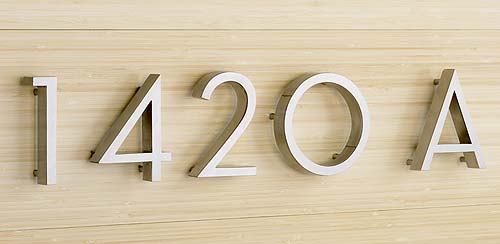
Easy Upgrade: Get a New Number


One of the easiest ways to upgrade the exterior look of your home--even if it is a dreary basement apartment--is to replace your address numbers. It's a modest investment that pays off. I mean, did you know that the picture at left was actually taken in front of a bus shelter?

Actually, that's a lie. The photo is from DWR's website, but you get the idea (and we don't really know that it WASN'T taken before a bus station, right?). Numbers, stylish mailboxes and perhaps some creative topiary, are tiny things you can easily change for a splashier impact.

Tuesday, September 26, 2006

Fancy Bottles for Your Non-Biodegradables


I was thumbing through the October Vogue, when the following fact jumped out at me: The average body wash, after it makes its swirly descent down the drain in to another dimension, takes about 300 years to biodegrade.

Now, I'm not the sort who frets about the biodegradability about everyday objects. I'm concerned about global warming and nasty oceans, but I also spend nearly 2 hours/day contemplating wallpaper colors. I'm also afraid that if I start wondering how quickly every item in my life will biodegrade, I'll start looking at people that way and well...that is just awful.

So Vogue recommends that we buy $60 soaps, which is fine if that is your lifestyle. You are paying not just for the zest of 1,000 lemons, but also very lovely packaging. Usually of the rustic, apothocary-like packaging that lets you know that you are not harming the world with your bathing habits.

But for the rest of us who buys cheapie biohazard liquid soap, we can pretend we are virtuous by decanting our soap in to a fancy bottle, such as this one, available at Fante's Kitchen Wares (1006 S. Ninth St.) for about $5. It takes slightly longer to pour out, so I recommend doing this with bubble-bath/leisure bathing soap, which tend to be a little more watery.

P.S. If you do pick up the October Vogue, be sure to peruse the story of Carolina Irving, beginning on page 396. I'm very enthusiastic about the way she displayed the Thomas Frye mezzotints on page 398.

Saturday, September 16, 2006

Dining Room Tables Are Very Good Investments

I've spent a few days trying to find an acceptable desk that has enough surface area for projects, but isn't a dreary eyesore that depresses you to the point of inactivity. Today's desk offerings tend to look as alien to the home as a cubicle or giant Xerox machine would.

I think I've said this before in the not-so-distant-past, but I fully believe and encourage everyone to eschew desks in favor of dining room tables. Yes, even if you have a microscopic apartment (you will come off as imaginative and charming when you throw all the rules regarding furniture scale out the window, by the way).

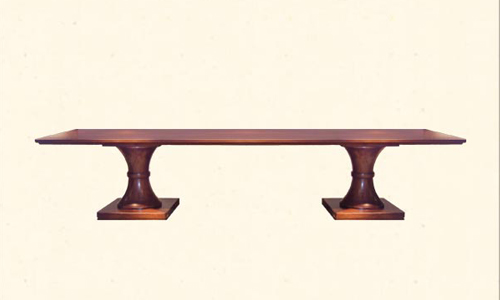
Here is the logic: Barely acceptable desks tend to cost just as much, and are not nearly as useful as a dining room table. A dining room table can accomodate all sorts of projects, tend to be better constructed and serve as a natural gathering point for your guests. And having a dining room table makes you feel like an interesting specimen that entertains constantly. You also have a place to hang a chandelier, which is always a bonus.

The above dining room table/desk is the Newport Dining Table from Usona Home (113 S. 16th). Made of solid walnut with two pedestal bases, the table is both classic and a bit off-beat. I don't have any particularly imaginative ideas regarding seating, but I do like the idea of this sort of bench seating and their complementary chair counterparts.

(photo from usonahome.com)

Tuesday, September 12, 2006

Today's Lesson: What Exactly is Capiz?


Capiz shells have been a big trend for a while, used mainly as wall hangings and in chandelier fixtures. I didn't pay too much attention to the material, since I found it to be cumbersome, noisy and well...a bit of a rip-off. I recall west elm selling three strands of skimpy, hanging capiz shell pendants strewn on fishing wire, at an alarming price for the quantity given.

Remember the big "tissue-weight cotton" layering trend of a few years back? You know it was just a trend manufactured in order to get unsuspecting shoppers to buy multiple tank tops. Same for the capiz shell pendants- they look lovely clustered together, but you'd need to spent about $200+ for a proper look.

Above, is a great example of how you can incorporate the luminous qualities of capiz shells without a lot of hassle, fishing wire, or dealing with unfair price points. It's a capiz bowl from Ten Thousand Villages (1122 Walnut St). Wouldn't it look fantastic with a bunch of lemons in it?

*Note: I've been told that capiz is actually a thin, off-white colored portion of the shell of a clam.

(photo from tenthousandvillages.com)

Friday, August 25, 2006

The Investment Chaise

Behold the $8,000+ chaise lounge.

If you have that sort of cash, then head over to the Baker Knapp & Tubbs showroom at the Philadelphia Marketplace Design Center (2400 Market St). Remember to bring your designer, as only licensed professionals can purchase from there.

However, you can indulge your fantasies by browsing during consumer hours (by reservation, I believe), or by heading over to the Baker website. I'm a big fan of Baker's wares, for offering luxurious contemporary interpretations of classic designs. The curved lines of this particular piece look very up-to-date, but the chaise is based on a Neoclassical era design. Overall, Baker's offerings are a very refreshing antidote for modern/mid-century overload.

Try juxaposing the classic pieces with these very neat mosaic tiles, available in Short Hills, NJ (amongst other places).

Tuesday, August 08, 2006

Giant Clocks for Giant Walls...

The average ceiling height in new construction homes (including condos) is rising. People want the illusion of space that tall walls create, but at the same time, are also frightened at the thought of living with them. Sometimes I think that people only look for high ceilings so they can buy giant christmas trees, but that's another story.

We've talked about using light and paint on big walls in order to get rid of the 'new construction' feeling. But accessories of proper scale are equally important. For example, there is nothing sadder than a massive wall with a normal sized (less than 1' foot diameter) clock. Big wall+Tiny Clock= Depressing apartment.

Twist Home (1134 Pine St) sells a variety of vintage European clock tower faces. They're real vintage, too- all manufactured between 1910-1920's. Though the prices seem high (starting at $2,400), I think you're getting a bargain when you consider the provenance. They'll also work in a smaller apartment, as you can see from the site's photos.

Sunday, June 04, 2006

The quest for decent-looking ceiling fans...

It's hot out. It's been stifling, unnecessarily, non-life-enhancing-ly hot for a past week now, and it's caught everyone by surprise. My unattractive air-conditioning unit (you know, those awful window-mounted models) was in storage, so I was left to wilt on a chaise lounge with a handkerchief. Just call me Blanche.

If the heat isn't enough to make you faint, consider this: An air-conditioning unit (whether you have central air, or the aforementioned window-mounted eyesore) wastes a TON of electricity. How much? In my quest for answers, I stumbled upon Michael Bluejay's page, which deals with saving electricity. Air conditioners use anywhere from 600-3500 watts of energy. If we switch to ceiling fans, we will save roughly $610 on our energy bills, which will be enough for each of us to buy a mid-price pair of Christian Louboutin sandles.

The problem is that ceiling fans can be even bigger eyesores than those air-conditioning units. They bring to mind the faux-country style that worms its way in to suburban households everywhere. Go in to the Home Depot or Lowe's and you will be visually assaulted by fake wood grains, fluted light bulb covers and caning, to the point where you will start to think that paying that extra $610 in energy costs might be worth it.

My advice: head over to Arch Street Lighting (120 Arch St.). Not only do they have a lovely and tasteful selection of lighting (side note: why does Home Depot/Lowe's consider "modern lighting" those pendant lamps that hang at Starbucks stores? That's all they have in terms of lighting that doesn't look salvaged from the set of Evening Shade, or perhaps a Cracker Barrel), but they have an equally well-edited selection of ceiling fans.

At left is the Centauru by Fanimation, which boasts satin nickel and cherry accents in a design that is a whimsical tribute to mid-century modern design and the Fairly Oddparents cartoon show. See more options here.

Friday, May 19, 2006

Modular Wallcovering.

One of the biggest trends last year was the InterfaceFlor Modular Carpet Tile System- with good reason, since it eliminated the circle of hell that is measuring for area carpeting. The customizable tiles made perfect sense for renters who wanted to add cheer to their apartments without incurring the wrath of a landlord, pet owners (each tile could be replaced easily) and those of us who can't commit to just one color of carpet.


Philadelphia-based MIO takes the modular concept one step further with their 3D wallcovering system. Each 12"x12" tile, made from recycled materials, is cut to produce a 3D effect. Mix and match the tiles (available in two styles: V2, left; and Flow) to create your own pattern.

Most use the tiles on just one area of a wall, but try tiling an entire room in one color. An entryway/foyer is an excellent place to start- just eliminate extraneous decorative accents. Juxtapose a traditional dining room set with walls covered in white V2 tiles. Keep the lighting low to soften the geometric effect.

Thursday, May 18, 2006

Have a Tea Party

Did you know that Philadelphians prefer tea over coffee, while New York prefers coffee over tea? I didn't either, until I heard a podcast from KYW on the subject of best places to get coffee and tea in the city. There was a nice gentleman from the Equal sweetener company who also insisted we mix Red Zinger (hibiscus) tea with Southern Comfort. Not really a morning person, I'd think.

Most of us are used to consuming bagged tea, mostly because loose tea is messy and we're not sure what to do with it. If you're thinking of making the fancy switch, you will need to start with a tea infuser of some sort. A tea ball (available from Remedy Tea Bar, 1628 Sansom St.), is very handy and easy to use, even if it does look like a microphone. I should also note that the people at Remedy take very kindly to people who are very new to the world of tea balls.

If you plan on having frequent tea parties, or just require more to your mornings, you should upgrade to a teapot with an infuser built in. The Bodum Tea Pot at Williams-Sonoma (200 S. Broad St.) is very basic, has a pleasing shape and a plunger that allows you to control the strength of the brew. The Flowering Tea Pot, also from Williams-Sonoma, is the Cirque du Soleil of tea- the included "tea flowers" bloom as they brew. The downside: The teapot is only 14-oz.

When you think of teacups, you normally think of porcelain. That's very nice, but I'm told it's not the most efficient material for consuming hot tea. Glass is the best, as it retains heat better than all other materials. Remedy has a selection of efficient tea-specific glassware, if you're so inclined.

Wednesday, May 17, 2006

Eschewing Velvet Ropes, but Keeping Style Intact.

Walking around Old City on Friday night- and I use the verb loosely, as crowds were so thick that I could've easily just allowed myself to be carried off to places unknown- I unofficially retired from going out on weekends in town. As the weather proceeds to get better, more and more people are coming out of their caves to come stand behind the increasing amount of velvet ropes, while wearing frightening amounts of synthetic material (disclosure: saw a girl in an 80's style neon dress, made entirely of nylon. Hope the bar was non-smoking).

Not only that, but it's getting pricier to go out, as the cost of living- and cocktails- steadily rises with rents. Though it pales in comparison to Manhattan, I have my reservations about sitting in an overcrowded faux-Irish pub sipping on an $11 concoction served in a plastic martini glass facsimile.

Unless you can afford to host a casual get-together at The Philadelphia Museum of Art, entertaining at home is the natural, lower-cost choice. Home entertaining is a trend on the rise, not only because of above financial/mental costs, but also because you can easily get all your friends in one place, without hassle.

But the thought of entertaining makes most people anxious. One minute you're planning a menu, the next, you're in near tears over the cleanliness of the bathroom. I say this because I felt the same way- and then I found the Purcell Sisters. Where most entertaining books either get too focused on fantasy (cashmere napkins and 30-year-old Balsamic Vinegar), or etiquette lessons, they constructed their book (Cocktail Parties, Straight Up!) based on entertaining with confidence, i.e. how not to have a melt down while figuring out drink menus. City dwellers themselves, they also take small spaces in to consideration, along with time constraints. A highly recommended read.

Wednesday, May 10, 2006

Taking the Terror out of Guest Soaps.

Is there anything as precious as The Guest Soap? They're always the prettiest and nicest smelling, to the point where they become off limits to everyone- even guests. My grandmother had a lovely set of hand-carved rose shaped guest soaps, which we were all terrified to use. For more than a decade, these beautiful creations sat untouched, the home decor equivalent of a museum exhibit, until a fine layer of dust relegated them to the trashbin.

That memory came to mind when I saw the collection of soaps at Town Home (126 S. 19th). In addition to the darling set of "see no evil/hear no evil/speak no evil" monkey soaps (left), there are pigs, frogs, poodles and chickens. Not keen on animals in the bathroom? Then take a peek at pears, rose petals and robins eggs.

Though lovely, these soaps are deliciously scented and adorable enough to make people want to use them. Encourage use by breaking up sets, setting one by the kitchen sink, another by the tub and the last on the bathroom sink. Guests will get the message that these soaps are, in fact, there to be used. Lightly suds them up beforehand to drive home the message.
What on earth can you do with an egg cup?

Was poking about Manor Home and Gifts (210 S. 17th) when I came across a collection of egg cups. Initially, I was delighted by the range of styles- pewter colonial chic, modern, french country and this curious one shaped like a head (left). But then the big question: What can you possibly use an egg cup for these days?

Since I'm merely domestically inclined, as opposed to domestic (can set a proper table, but haven't the time to cook a proper course), the obvious answer- for a soft-boiled egg- does not apply. And when was the last time someone ate a soft-boiled egg anyway?

So leaving out eggs, you can do the following with an egg cup, depending on the size and materials: You can use it as a small candle holder (indeed, one of the egg cups at Manor Home doubles as a votive holder); to hold a serving of sauce for something dippable; as a single-serving sugar bowl with coffee; filled with a bit of water and holding a single large-head flower, snipped just below the bud; or as a makeshift, yet tasteful, shot glass.

Monday, May 01, 2006

The Urban Home Office.

In the space-impaired urban nest, the home office area is a relative term. A small percentage of us have the luxury of a designated home office, while the rest of us make do with a disorganized corner of our sofas, or other inconvenient spot. One man's home office is another man's laundry room, after all.

Should you invest in a desk? If you actually work from home, have a demanding hobby, or are a student, then yes. A desk can be an excellent motivator for the procrastination-inclined. Having that specific spot to write your memoirs, study brain surgery or categorize your seed collection will inspire more productivity than the overstuffed Barcalounger dangerously close to a television.

Unfortunately, desks present a conundrum. You either get a spacious work surface, or you get clever storage, rarely both. Pick work area and watch those square inches pile up with clutter. Pick storage and you won't have enough surface room to sign checks. For the serious home worker, it's a better choice to select the "surface area" option, with a few alterations for the clutter-inclined. Start with a sensible desk, such as the B1 desk from Usona Home Furnishings (113 S. 16th), with drawers for the bare essentials: pencils and paper. Keep your address books, legal pads, calligraphy sets, commemorative inkwells and other items in a stool that doubles as storage, such as this Storage Cube from Pottery Barn (4230 Main St., Manayunk; Route 73, Marlton; King of Prussia Mall). For those who require back support, use the cubes as an ottoman, or stow under the desk.

A desk, no matter how well-designed, eats up precious square footage for the casual home worker. A dining room table can easily be re-purposed using a few techniques. First, find a place to keep your materials (pens, files, postage), such as a little-used nook in your china cabinet or on a bookshelf. A basket, such as this magazine holder from online retailer Hold Everything, keeps everything together and is sturdy enough to stand on its own.

For serious filers, make your own Portable Desk (in the spirit of hanging CD storage curtains). Buy a length of vinyl from the fabric store, and a cheap, cheery vinyl tablecloth from a discount retailer- think Target. Cut the vinyl in to varying sizes of rectangles and squares, and apply a strong-hold glue to three sides, producing a pocket. Drape over your table when it's time to work. The Portable Desk is very handy for filing bills and those other loose pieces of paper that tend to run away easily, and also works well as an outdoor desk- just spread the tablecloth on the grass, patio or table.

If you don't have a dining room table, pull up a bar stool (if you don't have one, visit Mr. Bar Stool, at 167 N. 2nd St.) to the counter. Make an office nook by hanging cork tiles, found at any office supply store, on the wall, or on to the refrigerator. If you own, consider adding a coat of chalk board paint to your refrigerator, wall, or cabinet for a writeable surface. Keep supplies in the closest drawer or cabinet.

Wednesday, April 26, 2006

Portable Glamour.

Space-conscious furniture has always been the L.L. Bean of the home design world- functional, yes. But pretty, stylish or fashionable? No.

But as our rooms and apartments get smaller while the home entertaining trend grows, the benefits of stackable, stowable or hideable furniture is obvious. So it's with this mindset that I set out to prove that foldability and good design aren't mutually exclusive ideas.

First, the folding chair. Folding chairs make sense because they solve the problem of having to force guests to sprawl out on the floor, and they can be easily be hidden away when not in use. Neiman Marcus (The Plaza at King of Prussia Mall) has an authentic antique folding chair, originally used at opera performances. Its curved lines and woven seat would be best highlighted in a white room.

Next, was Target. They're in a fit of pseudo-ethnic style at Target (Southeast Philadelphia, Cherry Hill, etc.), which gave me the feeling I was at Pier 1, right down to the potpourri. While I believe that style can be had at all price points, I don't see why "affordable" always has to go hand in hand with "Anonymous Eastern Country." The best option was the classic Director's Chair. It will juxtapose nicely in those pricey, library-esque living rooms. Word of warning: Director's Chairs are notoriously wobbly, so lower the gin content in that batch of Tom Collins.

The stackable chair is more abundant and quite often, better designed. The best place in Philadelphia is, hands down, Minima (118 N. 3rd). The Panton chair's curves and color options are cheery, while the Gigi Stacking, .03, and Fpe chairs have aerodynamic sleekness. Studio apartment dwellers take note- these options, especially the Panton chairs, don't look awful when stacked out in the open.