I'm always hesitant to pick up any of the effusive books/magazine articles that promise to let you in on the secrets to decorating your home cheaply and stylishly. Why? Because the tips are usually ridiculous--written by the sort of person who finds bliss in suggesting $300 towels, are far craftier than the general population (Make a lamp out of an old vodka bottle!) or are putting cheapness at a higher priority over quality.
It IS possible to furnish your home on a slight budget without sacrificing quality, style or even comfort. I know because I've managed to do it over the course of a year and a half, right down to the collection of 14 platinum-edged porcelain dinner plates ($3.50-$7.99 a piece) that I bought last week.
So get your piggy banks, here are the secrets to charm on the cheap, even if you're just starting out in your own hovel of an apartment:
1. Develop an eye for quality and style. Browse the high-end magazines for furniture ads or general setting photos. You're not doing this to follow trends, you're just honing your ability to spot high quality and expensive-looking styles. If you study, you'll be able to go to most secondhand stores (read: not vintage, not overpriced nonsense) and come out with something that looks antique. Or will at least know how to re-work a questionable item so it does look special.
2. Start saving--you'll need about $1,500-2,000 at most for this step. Winter (specifically January) and Summer (usually August) are the best times to buy high-ticket furniture for insane discounts. Really. I just bought a $3800 hand-carved table for an insane price. I have bought dresses for more than this table. Waiting for clearance sales=great payoffs.
3. Paint your rooms, if needed. As much as I hate saying this, do a neutral color. I know, I have coral pink walls, but if you're just starting out, it's hard enough buying furniture without having to worry about it matching a silver-and-watermelon-pink wallcovering. Pale buttercream, grey with the slightest twinge of pink, and regular cream are always flattering. Extend the paint on to the ceiling if you can for a more-finished look.
4.. Where to invest. Learn to live with the couch (or upholstered chairs) and dining room table you presently have. These two furniture pieces make a HUGE difference on your overall decor, you have no idea. Even if you fill your home with priceless curiousities, a cheap futon will ruin everything. Same goes for cheap tables with thick layers of plastic-looking veneer. Invest modestly in these two pieces. You will always use a couch and a nice big table. You can even use the table as desk, if you're pressed for space.
If you own a very tiny space--meaning no possible room for a dining room table--replace your counters and/or cabinetry. Huge difference.
In the meantime, get rid of your cheapest-looking, dreary stuff. If it can't be painted to look better, give it away.
5. Almost always, buy these items on sale at high-end places: Plates, drinking glasses and goblets, blankets/bedding, end/accent tables, decorate storage, pillows, drapes, rugs and tablecloths. Buy more plates and glasses than you think you need.
5.a. Usually buy solids, unless you see a pattern you adore. Make sure the curtains you buy aren't see through.
6. Almost always, buy these things second-hand, looking for the highest quality possible: Coffee tables, chairs, bureaus, headboards, mirrors, tall cabinets (instead of bookshelves or wall-mounted cabinets). Look for classic lines, good detailing and convincingly good construction. Don't worry about color or hardware--these can be replaced.
6.a. Don't buy anything with a cheap veneer. You know those cute chain stores that specialize in quasi-contemporary furnishings? Good for accessories, not for furnishings. In the catalogues, the stuff looks adorable, in person, terribly cheap. Save yourself the trouble.
7. Chandeliers and lamps can be bought anywhere, even chain stores. Remember that people will notice them, and that you can also paint these (albeit carefully). Don't buy torchiere lamps.
These are the general rules for starting out in style, while not spending too much. If you always buy high-quality in a neutral pattern, you won't have to worry about mixing and matching. You'll look charming, not adrift.
Showing posts with label Large Space. Show all posts
Showing posts with label Large Space. Show all posts
Wednesday, January 17, 2007
Wednesday, January 10, 2007
New Year, New Lighting

Isn't this a marvelous pendant lamp? At first, I thought I was looking a fixture inspired by a fancy seashell (forgive my glaring lack of marine science knowledge--the seashell I'm referring to resembles a puffy round ottoman or floor cushion), but then I saw the chandelier arms poking through the covering. Love that duality, along with the way the covering adds mass without sacrificing light. The pendant is the "Zeppelin" by Flos. It's designed by Marcel Wanders and is available through OLC (152-154 N. Third St).
Sidenote: Maybe it is the new year, but I'm leaning more towards neutrals as of late. Shopping the post-holiday sales, I picked up a set of 10 platinum-edged white china plates along with a few place settings of pearlized-handled silverware.

Monday, November 27, 2006
Divide and Conquer

As in life, we all might live better with a few boundaries.
Many new construction homes/apartments are of the “loft-inspired” or open floor plan. It’s a no-brainer as to why people like these plans—you get lots of spaciousness, control over where you can arrange your furniture and you don’t have to navigate around doorways when moving in. The issue usually comes up with how to properly define a space when there aren’t any rooms.
I’ve found a solution with the Textile Softwall, available through Design Within Reach (1710 Walnut St.). The Softwall is exactly what it sounds like: a soft wall. It’s made out of environmentally sound materials, portable and soundproof. When standing, the wall’s curvy shape is a more visually interesting alternative to traditional dividers. The Softwall also allows natural light to filter through, no small feat for a partition.
Though it’s a bit pricey for some budgets, I’d say that this was a smart investment for some individuals. You can use it as a general room divider, as a way to section off your home office space, or as an outdoor privacy screen.
Many new construction homes/apartments are of the “loft-inspired” or open floor plan. It’s a no-brainer as to why people like these plans—you get lots of spaciousness, control over where you can arrange your furniture and you don’t have to navigate around doorways when moving in. The issue usually comes up with how to properly define a space when there aren’t any rooms.
I’ve found a solution with the Textile Softwall, available through Design Within Reach (1710 Walnut St.). The Softwall is exactly what it sounds like: a soft wall. It’s made out of environmentally sound materials, portable and soundproof. When standing, the wall’s curvy shape is a more visually interesting alternative to traditional dividers. The Softwall also allows natural light to filter through, no small feat for a partition.
Though it’s a bit pricey for some budgets, I’d say that this was a smart investment for some individuals. You can use it as a general room divider, as a way to section off your home office space, or as an outdoor privacy screen.
Photo from dwr.com
Monday, November 13, 2006
Much Ado About Antiques
I was positively suckered in to reading an article in the New York Times H&G section last week, merely because the accompanying photographed included Joan Rivers and folk art. Not that I have a particular interest in Joan Rivers and folk art, mind you, I just enjoyed the juxtaposition.
(Here is the article, in case you didn't see)
Well, not only was there scant information about Ms. Rivers and her folk art, the article turned out to be a very serious investigation on what well-heeled people worry most about: What their designers think of their family hand-me-downs and antique purchases.
To wit, "You know these pieces: The baroque, over-size bedroom set, fit for the home of a mountain king; the circular mahogany table that seats 14. Angèle Parlange, who grew up in an 18th-century Louisiana plantation house and is the author of “Creole Thrift,” just published by ReganBooks, calls it “big brown furniture.” And unlike the mistakes you make at a flea market and can unload on eBay, when you take this stuff home, you’re stuck for life."
What a limited and dreary world view to have. I was highly appalled by the glaring lack of imagination that I felt a need to give some soothing tips on what to do with your antiques:
-Paint it gold. Unless Aunt Mimi wrote a brilliant manifesto on her writing desk, feel free to paint it gold, replace the hardware and use it as a mini-bar. Aunt Mimi probably used it in that respect, albeit informally. If you're short on space, take the doors off a closet and place in there. You can always stuff your ill-fitting sweaters and stretched-out bathing suits somewhere else.
-Make a dining room. Even if you have the most microscopic apartment, it will behoove you to make your own dining room. If given the choice between some clunky entertainment center and uncomfortable futons, and a circular mahogany table for 14...you are better off with the table, a deck of cards, and the phone number of the nearest hotel for your dear friends. Throw caution to the wind, when it comes to scale.
-Burn bridges. Some people WILL be cross with you if you start painting "antiques." The resulting grudge will only be short-term, and really, you probably needed a break from their presence/phone conversations anyway.
(Here is the article, in case you didn't see)
Well, not only was there scant information about Ms. Rivers and her folk art, the article turned out to be a very serious investigation on what well-heeled people worry most about: What their designers think of their family hand-me-downs and antique purchases.
To wit, "You know these pieces: The baroque, over-size bedroom set, fit for the home of a mountain king; the circular mahogany table that seats 14. Angèle Parlange, who grew up in an 18th-century Louisiana plantation house and is the author of “Creole Thrift,” just published by ReganBooks, calls it “big brown furniture.” And unlike the mistakes you make at a flea market and can unload on eBay, when you take this stuff home, you’re stuck for life."
What a limited and dreary world view to have. I was highly appalled by the glaring lack of imagination that I felt a need to give some soothing tips on what to do with your antiques:
-Paint it gold. Unless Aunt Mimi wrote a brilliant manifesto on her writing desk, feel free to paint it gold, replace the hardware and use it as a mini-bar. Aunt Mimi probably used it in that respect, albeit informally. If you're short on space, take the doors off a closet and place in there. You can always stuff your ill-fitting sweaters and stretched-out bathing suits somewhere else.
-Make a dining room. Even if you have the most microscopic apartment, it will behoove you to make your own dining room. If given the choice between some clunky entertainment center and uncomfortable futons, and a circular mahogany table for 14...you are better off with the table, a deck of cards, and the phone number of the nearest hotel for your dear friends. Throw caution to the wind, when it comes to scale.
-Burn bridges. Some people WILL be cross with you if you start painting "antiques." The resulting grudge will only be short-term, and really, you probably needed a break from their presence/phone conversations anyway.
Saturday, September 16, 2006
Dining Room Tables Are Very Good Investments
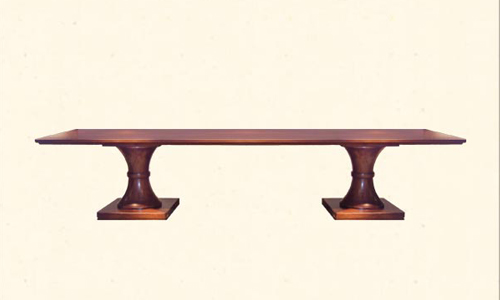 I've spent a few days trying to find an acceptable desk that has enough surface area for projects, but isn't a dreary eyesore that depresses you to the point of inactivity. Today's desk offerings tend to look as alien to the home as a cubicle or giant Xerox machine would.
I think I've said this before in the not-so-distant-past, but I fully believe and encourage everyone to eschew desks in favor of dining room tables. Yes, even if you have a microscopic apartment (you will come off as imaginative and charming when you throw all the rules regarding furniture scale out the window, by the way).
Here is the logic: Barely acceptable desks tend to cost just as much, and are not nearly as useful as a dining room table. A dining room table can accomodate all sorts of projects, tend to be better constructed and serve as a natural gathering point for your guests. And having a dining room table makes you feel like an interesting specimen that entertains constantly. You also have a place to hang a chandelier, which is always a bonus.
The above dining room table/desk is the Newport Dining Table from Usona Home (113 S. 16th). Made of solid walnut with two pedestal bases, the table is both classic and a bit off-beat. I don't have any particularly imaginative ideas regarding seating, but I do like the idea of this sort of bench seating and their complementary chair counterparts.
(photo from usonahome.com)
Tuesday, September 05, 2006
Instant Chandelier

So maybe I am the last person to sing the praises of Tord Boontje's Garland Light, which has been all over the design magazines for the past year now. Just add my voice to the chorus.
It's well-deserved praise, though. Unlike most light fixtures, the Garland Light doesn't require an entire afternoon devoted to installation (the garland portion clips on to a bulb). The garland also doesn't obscure the light source, so the piece remains functional instead of purely decorative. You can also control the length of the garland- stretch it for an odd stairway, or leave it massed around the bulb for use in closer quarters.
The Garland Light, at $60, is relatively affordable for the design quality and the overall impact it makes. Available through the AIA Bookstore and Design Center (17th and Samson).
(photo from AIA Bookstore)
Tuesday, August 22, 2006
Your Bed Also Counts As Furniture
Looking for a new bed? Head to Princeton. It's nearly enough to make you wish that you still lived in a studio apartment, if only so more people could see this fabulous piece of furniture.
Actually, nothing is enough to make one wish they lived in a studio apartment. But you catch my drift.
Actually, nothing is enough to make one wish they lived in a studio apartment. But you catch my drift.
Tuesday, August 08, 2006
Giant Clocks for Giant Walls...
The average ceiling height in new construction homes (including condos) is rising. People want the illusion of space that tall walls create, but at the same time, are also frightened at the thought of living with them. Sometimes I think that people only look for high ceilings so they can buy giant christmas trees, but that's another story.
We've talked about using light and paint on big walls in order to get rid of the 'new construction' feeling. But accessories of proper scale are equally important. For example, there is nothing sadder than a massive wall with a normal sized (less than 1' foot diameter) clock. Big wall+Tiny Clock= Depressing apartment.
Twist Home (1134 Pine St) sells a variety of vintage European clock tower faces. They're real vintage, too- all manufactured between 1910-1920's. Though the prices seem high (starting at $2,400), I think you're getting a bargain when you consider the provenance. They'll also work in a smaller apartment, as you can see from the site's photos.
The average ceiling height in new construction homes (including condos) is rising. People want the illusion of space that tall walls create, but at the same time, are also frightened at the thought of living with them. Sometimes I think that people only look for high ceilings so they can buy giant christmas trees, but that's another story.
We've talked about using light and paint on big walls in order to get rid of the 'new construction' feeling. But accessories of proper scale are equally important. For example, there is nothing sadder than a massive wall with a normal sized (less than 1' foot diameter) clock. Big wall+Tiny Clock= Depressing apartment.
Twist Home (1134 Pine St) sells a variety of vintage European clock tower faces. They're real vintage, too- all manufactured between 1910-1920's. Though the prices seem high (starting at $2,400), I think you're getting a bargain when you consider the provenance. They'll also work in a smaller apartment, as you can see from the site's photos.
Friday, July 14, 2006
Saw some neat lighting options at Artemide (232 N. 2nd).
First, there's the Dioscuri wall/ceiling lamp. It works indoors, as well as outdoors. What's keeping it from looking like one of those tragic touch-lights, is that there is minimal contact between the sphere casing and the wall. It appears to float. The scale is a bit small- would look VERY skimpy and sad on its own. Buy multiples, and scatter them all over the wall. Would be a stunning effect on an outdoor wall.
The Logico Ceiling Triple Linear is a very tastefully restrained alternative for those of you who dislike the vintage look of most chandeliers on the market. Instead of relying on straight planes, like most 'modern' chandelier-type fixtures, it relies on the movement of wavy forms and the texture of the glass in order to add that unexpected element to your home. Would work best over a very rectilinear dining room table, perhaps with a high gloss to contrast with the softer form and texture. The reflected light would look best with a ceiling painted in a cool-toned metallic color. Works best with low-to-average height ceilings.
DZ 818, an outdoor light source, brings to mind those old, 19th Century cast iron outdoor lights (maybe it's the way the metal appears, or the curve of the arm). The light is just bright enough to illuminate the front of your home, but not so bright that it attracts moths and unsavory types. Works best for citydwellers, especially those in historic districts with near-identical brick homes. Use two.
And finally, the surf sconce. Many buildings, particularly those in the neoclassical style, use dramatic up-lights to highlight intricate architectural details at night. For those who are currently rushing to buy high-ceilinged apartments, this is the indoor equivalent to outdoor architectural lighting. Because at the end of the day, you're left with all that wall space and nothing to do with it. The right, soft, lighting will make even the most basic molding look grand.
First, there's the Dioscuri wall/ceiling lamp. It works indoors, as well as outdoors. What's keeping it from looking like one of those tragic touch-lights, is that there is minimal contact between the sphere casing and the wall. It appears to float. The scale is a bit small- would look VERY skimpy and sad on its own. Buy multiples, and scatter them all over the wall. Would be a stunning effect on an outdoor wall.
The Logico Ceiling Triple Linear is a very tastefully restrained alternative for those of you who dislike the vintage look of most chandeliers on the market. Instead of relying on straight planes, like most 'modern' chandelier-type fixtures, it relies on the movement of wavy forms and the texture of the glass in order to add that unexpected element to your home. Would work best over a very rectilinear dining room table, perhaps with a high gloss to contrast with the softer form and texture. The reflected light would look best with a ceiling painted in a cool-toned metallic color. Works best with low-to-average height ceilings.
DZ 818, an outdoor light source, brings to mind those old, 19th Century cast iron outdoor lights (maybe it's the way the metal appears, or the curve of the arm). The light is just bright enough to illuminate the front of your home, but not so bright that it attracts moths and unsavory types. Works best for citydwellers, especially those in historic districts with near-identical brick homes. Use two.
And finally, the surf sconce. Many buildings, particularly those in the neoclassical style, use dramatic up-lights to highlight intricate architectural details at night. For those who are currently rushing to buy high-ceilinged apartments, this is the indoor equivalent to outdoor architectural lighting. Because at the end of the day, you're left with all that wall space and nothing to do with it. The right, soft, lighting will make even the most basic molding look grand.
Friday, May 19, 2006
Modular Wallcovering.
One of the biggest trends last year was the InterfaceFlor Modular Carpet Tile System- with good reason, since it eliminated the circle of hell that is measuring for area carpeting. The customizable tiles made perfect sense for renters who wanted to add cheer to their apartments without incurring the wrath of a landlord, pet owners (each tile could be replaced easily) and those of us who can't commit to just one color of carpet.

Philadelphia-based MIO takes the modular concept one step further with their 3D wallcovering system. Each 12"x12" tile, made from recycled materials, is cut to produce a 3D effect. Mix and match the tiles (available in two styles: V2, left; and Flow) to create your own pattern.
Most use the tiles on just one area of a wall, but try tiling an entire room in one color. An entryway/foyer is an excellent place to start- just eliminate extraneous decorative accents. Juxtapose a traditional dining room set with walls covered in white V2 tiles. Keep the lighting low to soften the geometric effect.
One of the biggest trends last year was the InterfaceFlor Modular Carpet Tile System- with good reason, since it eliminated the circle of hell that is measuring for area carpeting. The customizable tiles made perfect sense for renters who wanted to add cheer to their apartments without incurring the wrath of a landlord, pet owners (each tile could be replaced easily) and those of us who can't commit to just one color of carpet.

Philadelphia-based MIO takes the modular concept one step further with their 3D wallcovering system. Each 12"x12" tile, made from recycled materials, is cut to produce a 3D effect. Mix and match the tiles (available in two styles: V2, left; and Flow) to create your own pattern.
Most use the tiles on just one area of a wall, but try tiling an entire room in one color. An entryway/foyer is an excellent place to start- just eliminate extraneous decorative accents. Juxtapose a traditional dining room set with walls covered in white V2 tiles. Keep the lighting low to soften the geometric effect.
Subscribe to:
Posts (Atom)


