I'm always hesitant to pick up any of the effusive books/magazine articles that promise to let you in on the secrets to decorating your home cheaply and stylishly. Why? Because the tips are usually ridiculous--written by the sort of person who finds bliss in suggesting $300 towels, are far craftier than the general population (Make a lamp out of an old vodka bottle!) or are putting cheapness at a higher priority over quality.
It IS possible to furnish your home on a slight budget without sacrificing quality, style or even comfort. I know because I've managed to do it over the course of a year and a half, right down to the collection of 14 platinum-edged porcelain dinner plates ($3.50-$7.99 a piece) that I bought last week.
So get your piggy banks, here are the secrets to charm on the cheap, even if you're just starting out in your own hovel of an apartment:
1. Develop an eye for quality and style. Browse the high-end magazines for furniture ads or general setting photos. You're not doing this to follow trends, you're just honing your ability to spot high quality and expensive-looking styles. If you study, you'll be able to go to most secondhand stores (read: not vintage, not overpriced nonsense) and come out with something that looks antique. Or will at least know how to re-work a questionable item so it does look special.
2. Start saving--you'll need about $1,500-2,000 at most for this step. Winter (specifically January) and Summer (usually August) are the best times to buy high-ticket furniture for insane discounts. Really. I just bought a $3800 hand-carved table for an insane price. I have bought dresses for more than this table. Waiting for clearance sales=great payoffs.
3. Paint your rooms, if needed. As much as I hate saying this, do a neutral color. I know, I have coral pink walls, but if you're just starting out, it's hard enough buying furniture without having to worry about it matching a silver-and-watermelon-pink wallcovering. Pale buttercream, grey with the slightest twinge of pink, and regular cream are always flattering. Extend the paint on to the ceiling if you can for a more-finished look.
4.. Where to invest. Learn to live with the couch (or upholstered chairs) and dining room table you presently have. These two furniture pieces make a HUGE difference on your overall decor, you have no idea. Even if you fill your home with priceless curiousities, a cheap futon will ruin everything. Same goes for cheap tables with thick layers of plastic-looking veneer. Invest modestly in these two pieces. You will always use a couch and a nice big table. You can even use the table as desk, if you're pressed for space.
If you own a very tiny space--meaning no possible room for a dining room table--replace your counters and/or cabinetry. Huge difference.
In the meantime, get rid of your cheapest-looking, dreary stuff. If it can't be painted to look better, give it away.
5. Almost always, buy these items on sale at high-end places: Plates, drinking glasses and goblets, blankets/bedding, end/accent tables, decorate storage, pillows, drapes, rugs and tablecloths. Buy more plates and glasses than you think you need.
5.a. Usually buy solids, unless you see a pattern you adore. Make sure the curtains you buy aren't see through.
6. Almost always, buy these things second-hand, looking for the highest quality possible: Coffee tables, chairs, bureaus, headboards, mirrors, tall cabinets (instead of bookshelves or wall-mounted cabinets). Look for classic lines, good detailing and convincingly good construction. Don't worry about color or hardware--these can be replaced.
6.a. Don't buy anything with a cheap veneer. You know those cute chain stores that specialize in quasi-contemporary furnishings? Good for accessories, not for furnishings. In the catalogues, the stuff looks adorable, in person, terribly cheap. Save yourself the trouble.
7. Chandeliers and lamps can be bought anywhere, even chain stores. Remember that people will notice them, and that you can also paint these (albeit carefully). Don't buy torchiere lamps.
These are the general rules for starting out in style, while not spending too much. If you always buy high-quality in a neutral pattern, you won't have to worry about mixing and matching. You'll look charming, not adrift.
Showing posts with label Small Space. Show all posts
Showing posts with label Small Space. Show all posts
Wednesday, January 17, 2007
Wednesday, January 10, 2007
New Year, New Lighting

Isn't this a marvelous pendant lamp? At first, I thought I was looking a fixture inspired by a fancy seashell (forgive my glaring lack of marine science knowledge--the seashell I'm referring to resembles a puffy round ottoman or floor cushion), but then I saw the chandelier arms poking through the covering. Love that duality, along with the way the covering adds mass without sacrificing light. The pendant is the "Zeppelin" by Flos. It's designed by Marcel Wanders and is available through OLC (152-154 N. Third St).
Sidenote: Maybe it is the new year, but I'm leaning more towards neutrals as of late. Shopping the post-holiday sales, I picked up a set of 10 platinum-edged white china plates along with a few place settings of pearlized-handled silverware.

Wednesday, November 15, 2006
A Place to Hang Your Stockings and Other Holiday Objects
Mantels are fantastic for creating a tasteful focal point for apartments and small spaces. The Home Depot has a few on sale, just in time for holiday entertaining. See the New Jersey blog for more details.
Monday, November 13, 2006
Much Ado About Antiques
I was positively suckered in to reading an article in the New York Times H&G section last week, merely because the accompanying photographed included Joan Rivers and folk art. Not that I have a particular interest in Joan Rivers and folk art, mind you, I just enjoyed the juxtaposition.
(Here is the article, in case you didn't see)
Well, not only was there scant information about Ms. Rivers and her folk art, the article turned out to be a very serious investigation on what well-heeled people worry most about: What their designers think of their family hand-me-downs and antique purchases.
To wit, "You know these pieces: The baroque, over-size bedroom set, fit for the home of a mountain king; the circular mahogany table that seats 14. Angèle Parlange, who grew up in an 18th-century Louisiana plantation house and is the author of “Creole Thrift,” just published by ReganBooks, calls it “big brown furniture.” And unlike the mistakes you make at a flea market and can unload on eBay, when you take this stuff home, you’re stuck for life."
What a limited and dreary world view to have. I was highly appalled by the glaring lack of imagination that I felt a need to give some soothing tips on what to do with your antiques:
-Paint it gold. Unless Aunt Mimi wrote a brilliant manifesto on her writing desk, feel free to paint it gold, replace the hardware and use it as a mini-bar. Aunt Mimi probably used it in that respect, albeit informally. If you're short on space, take the doors off a closet and place in there. You can always stuff your ill-fitting sweaters and stretched-out bathing suits somewhere else.
-Make a dining room. Even if you have the most microscopic apartment, it will behoove you to make your own dining room. If given the choice between some clunky entertainment center and uncomfortable futons, and a circular mahogany table for 14...you are better off with the table, a deck of cards, and the phone number of the nearest hotel for your dear friends. Throw caution to the wind, when it comes to scale.
-Burn bridges. Some people WILL be cross with you if you start painting "antiques." The resulting grudge will only be short-term, and really, you probably needed a break from their presence/phone conversations anyway.
(Here is the article, in case you didn't see)
Well, not only was there scant information about Ms. Rivers and her folk art, the article turned out to be a very serious investigation on what well-heeled people worry most about: What their designers think of their family hand-me-downs and antique purchases.
To wit, "You know these pieces: The baroque, over-size bedroom set, fit for the home of a mountain king; the circular mahogany table that seats 14. Angèle Parlange, who grew up in an 18th-century Louisiana plantation house and is the author of “Creole Thrift,” just published by ReganBooks, calls it “big brown furniture.” And unlike the mistakes you make at a flea market and can unload on eBay, when you take this stuff home, you’re stuck for life."
What a limited and dreary world view to have. I was highly appalled by the glaring lack of imagination that I felt a need to give some soothing tips on what to do with your antiques:
-Paint it gold. Unless Aunt Mimi wrote a brilliant manifesto on her writing desk, feel free to paint it gold, replace the hardware and use it as a mini-bar. Aunt Mimi probably used it in that respect, albeit informally. If you're short on space, take the doors off a closet and place in there. You can always stuff your ill-fitting sweaters and stretched-out bathing suits somewhere else.
-Make a dining room. Even if you have the most microscopic apartment, it will behoove you to make your own dining room. If given the choice between some clunky entertainment center and uncomfortable futons, and a circular mahogany table for 14...you are better off with the table, a deck of cards, and the phone number of the nearest hotel for your dear friends. Throw caution to the wind, when it comes to scale.
-Burn bridges. Some people WILL be cross with you if you start painting "antiques." The resulting grudge will only be short-term, and really, you probably needed a break from their presence/phone conversations anyway.
Thursday, November 02, 2006
No, It's Not an Upholstered Coffin
 This is actually an upholstered leather bench, available through Scarlett Alley (241 Race St.). The top opens up, allowing you to store all sorts of goodies and messes. When closed, it can provide extra seating while looking unassuming. I certainly wouldn't think this stylish little number was actually full of incidentals.
I also like the tailored, confirmed-bachelor-esque qualities inherent in this piece. It's the same feeling you get from a Chesterfield sofa--you're ten times more interesting when you sit on one, and also ten times more likely to drink out of a conspicuous silver flask.
Photo from ScarlettAlley.com
Monday, October 30, 2006
The Solution For Ugly Ceilings
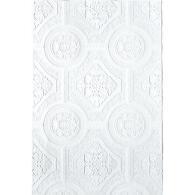 If you have ugly ceilings, the quick solution is this pre-pasted faux ceiling tile "wallpaper," available at Lowe's (2106 S. Christopher Columbus Blvd.) . The paper is pre-glued, meaning easy installation (tips on that later this week) and ready-to-paint. I recommend an unusual shade- try hot pink or canary yellow if you're particularly adventurous, but Ralph Lauren's gold or silver will also work wonderfully. You can peel this away easily, so why not make a statement?
Saturday, September 16, 2006
Dining Room Tables Are Very Good Investments
 I've spent a few days trying to find an acceptable desk that has enough surface area for projects, but isn't a dreary eyesore that depresses you to the point of inactivity. Today's desk offerings tend to look as alien to the home as a cubicle or giant Xerox machine would.
I think I've said this before in the not-so-distant-past, but I fully believe and encourage everyone to eschew desks in favor of dining room tables. Yes, even if you have a microscopic apartment (you will come off as imaginative and charming when you throw all the rules regarding furniture scale out the window, by the way).
Here is the logic: Barely acceptable desks tend to cost just as much, and are not nearly as useful as a dining room table. A dining room table can accomodate all sorts of projects, tend to be better constructed and serve as a natural gathering point for your guests. And having a dining room table makes you feel like an interesting specimen that entertains constantly. You also have a place to hang a chandelier, which is always a bonus.
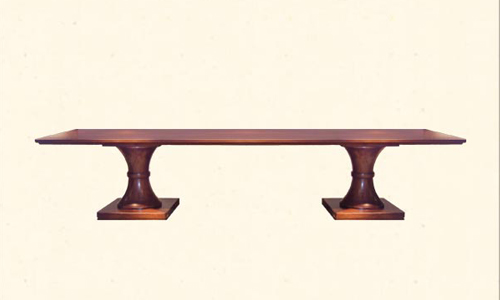
The above dining room table/desk is the Newport Dining Table from Usona Home (113 S. 16th). Made of solid walnut with two pedestal bases, the table is both classic and a bit off-beat. I don't have any particularly imaginative ideas regarding seating, but I do like the idea of this sort of bench seating and their complementary chair counterparts.
(photo from usonahome.com)
Tuesday, September 05, 2006
Instant Chandelier

So maybe I am the last person to sing the praises of Tord Boontje's Garland Light, which has been all over the design magazines for the past year now. Just add my voice to the chorus.
It's well-deserved praise, though. Unlike most light fixtures, the Garland Light doesn't require an entire afternoon devoted to installation (the garland portion clips on to a bulb). The garland also doesn't obscure the light source, so the piece remains functional instead of purely decorative. You can also control the length of the garland- stretch it for an odd stairway, or leave it massed around the bulb for use in closer quarters.
The Garland Light, at $60, is relatively affordable for the design quality and the overall impact it makes. Available through the AIA Bookstore and Design Center (17th and Samson).
(photo from AIA Bookstore)
Thursday, August 31, 2006
The #1 Decorating Solution For Renters and Other Transients
I have a small spot in my heart for renters. It’s not as big as the spot for Schnapps bears, but one look at that link and it’s obvious why. But I really do sympathize with the plights of renters these days.
First of all, they have to constantly fear that a developer will come in to their building, then convert it in to $500,000+ condos, forcing them in to a seedier part of town. Until the forces of gentrification invade that neighborhood, and so on, until those who can’t afford to buy will be relegated to the Delaware River.
But some renters also have to put up with landlords who won’t allow one speck of color on the walls, producing depressing off-white rooms that marginalize your existence even further. One minute, you feel like a sassy grown-up, the next, you’re looking at the lone pathetic art reproduction poster illuminated by a torchier lamp and wondering what went wrong.
So I was excited when I saw the wall clings, discussed in the previous entry. But once I saw the gentrification-like price of those scraps of vinyl, I got angry. And while I may not be able to fight market forces, I can offer you a solution for your bare walls.
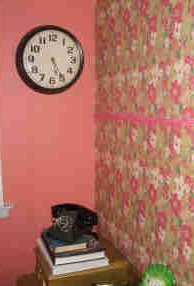
Look at the above left photo (of my office, as indicated by the coffee table books and rotary phone). You’re thinking “Well that sure is a busy wallpaper pattern. Did she steal that from the set of the Mary Tyler Moore show?”
But you're wrong. It's not wallpaper; it's $12 worth of fabric from the local crafts store, with a short length of pom-pom fringe. Underneath all of that color, is roughly 3-4 rolls of double-stick heavy-duty wall mounting tape. Put these items together, rope off about 3 hours of your evening, and your wall can also be enhanced by a little no-damage very cheap faux upholstery. (exhale)
I recommend applying the tape in three foot squares. Place the short end of the fabric length on the horizontal axis of the wall, pressing hard to make sure you get it nice and stuck to the tape. Proceed across the wall. Cover up any unsightly seams with fringe, or ribbon (this is why I advocate working horizontally). Try to use a fabric with a slight stretch to it- here I used a sort of lightweight flannel. The whole project set me back maybe $30. That price won't even get you a packet of wall clings.
NOTE: Obviously...applying zingy fabrics to the wall makes your entire room 10 times more flammable. Be careful with your novelty candles.
Dorm Residents: This is the perfect way to tone down the industrial, soviet bloc-style room you live in. It's also easily removable with a strong tug, in case the pesky RA enters.
Temporary Wall Decor
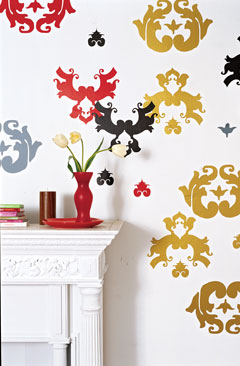
Available exclusively online through the Philadelphia-based company Urban Outfitters, the Blick Wall Sticks are temporary decals that you can apply to your walls for a small dose of movable cheer. Finally, a retailer extends the décor offerings for college students beyond butterfly chairs, scratchy x-long sheets and $20 milk crate containers.
These also are great for renters with particularly restrictive landlords (sidenote: forcing your inhabitants to live in rooms devoid of any color should be regarded as tenant abuse, in my opinion).
Do I think the wall graphics are a great idea? Yes. But I do have my reservations. First of all, the price point, at $38, is a bit high for essentially a piece of vinyl (this isn’t the highest price either- Target offers a similar package, but for $58). Fancy, but still cut vinyl. They also don’t offer you enough for your money—in order to make an effective design statement with these, you’d have to buy multiple packs.
I do have a much better solution, specifically for renters. The tips will be posted tonight at 10:30 p.m. (EST).
Thursday, August 24, 2006
Make Your Furniture Work Harder, Even When You're Not

Behold the official Leisure Table. Okay, that is not its real name. This is actually the Usame side table by Kartell from minima (118 N. 3rd).
I call it the Leisure Table because it would be perfect for coffee-and-magazine time, which officially occurs between 7 and 10 p.m. just in case you didn't know. Adjust your schedule accordingly.
Meant to be used as a side table, bed tray or accent piece, Usame resists stains while adding much needed color or subtle femininity (Art Deco inspired flowers are etched in to its surface). Magazines fit in to a cut out compartment, and coffee...well that can go anywhere. No coasters necessary.
Friday, July 14, 2006
Saw some neat lighting options at Artemide (232 N. 2nd).
First, there's the Dioscuri wall/ceiling lamp. It works indoors, as well as outdoors. What's keeping it from looking like one of those tragic touch-lights, is that there is minimal contact between the sphere casing and the wall. It appears to float. The scale is a bit small- would look VERY skimpy and sad on its own. Buy multiples, and scatter them all over the wall. Would be a stunning effect on an outdoor wall.
The Logico Ceiling Triple Linear is a very tastefully restrained alternative for those of you who dislike the vintage look of most chandeliers on the market. Instead of relying on straight planes, like most 'modern' chandelier-type fixtures, it relies on the movement of wavy forms and the texture of the glass in order to add that unexpected element to your home. Would work best over a very rectilinear dining room table, perhaps with a high gloss to contrast with the softer form and texture. The reflected light would look best with a ceiling painted in a cool-toned metallic color. Works best with low-to-average height ceilings.
DZ 818, an outdoor light source, brings to mind those old, 19th Century cast iron outdoor lights (maybe it's the way the metal appears, or the curve of the arm). The light is just bright enough to illuminate the front of your home, but not so bright that it attracts moths and unsavory types. Works best for citydwellers, especially those in historic districts with near-identical brick homes. Use two.
And finally, the surf sconce. Many buildings, particularly those in the neoclassical style, use dramatic up-lights to highlight intricate architectural details at night. For those who are currently rushing to buy high-ceilinged apartments, this is the indoor equivalent to outdoor architectural lighting. Because at the end of the day, you're left with all that wall space and nothing to do with it. The right, soft, lighting will make even the most basic molding look grand.
First, there's the Dioscuri wall/ceiling lamp. It works indoors, as well as outdoors. What's keeping it from looking like one of those tragic touch-lights, is that there is minimal contact between the sphere casing and the wall. It appears to float. The scale is a bit small- would look VERY skimpy and sad on its own. Buy multiples, and scatter them all over the wall. Would be a stunning effect on an outdoor wall.
The Logico Ceiling Triple Linear is a very tastefully restrained alternative for those of you who dislike the vintage look of most chandeliers on the market. Instead of relying on straight planes, like most 'modern' chandelier-type fixtures, it relies on the movement of wavy forms and the texture of the glass in order to add that unexpected element to your home. Would work best over a very rectilinear dining room table, perhaps with a high gloss to contrast with the softer form and texture. The reflected light would look best with a ceiling painted in a cool-toned metallic color. Works best with low-to-average height ceilings.
DZ 818, an outdoor light source, brings to mind those old, 19th Century cast iron outdoor lights (maybe it's the way the metal appears, or the curve of the arm). The light is just bright enough to illuminate the front of your home, but not so bright that it attracts moths and unsavory types. Works best for citydwellers, especially those in historic districts with near-identical brick homes. Use two.
And finally, the surf sconce. Many buildings, particularly those in the neoclassical style, use dramatic up-lights to highlight intricate architectural details at night. For those who are currently rushing to buy high-ceilinged apartments, this is the indoor equivalent to outdoor architectural lighting. Because at the end of the day, you're left with all that wall space and nothing to do with it. The right, soft, lighting will make even the most basic molding look grand.
Friday, May 19, 2006
Modular Wallcovering.
One of the biggest trends last year was the InterfaceFlor Modular Carpet Tile System- with good reason, since it eliminated the circle of hell that is measuring for area carpeting. The customizable tiles made perfect sense for renters who wanted to add cheer to their apartments without incurring the wrath of a landlord, pet owners (each tile could be replaced easily) and those of us who can't commit to just one color of carpet.

Philadelphia-based MIO takes the modular concept one step further with their 3D wallcovering system. Each 12"x12" tile, made from recycled materials, is cut to produce a 3D effect. Mix and match the tiles (available in two styles: V2, left; and Flow) to create your own pattern.
Most use the tiles on just one area of a wall, but try tiling an entire room in one color. An entryway/foyer is an excellent place to start- just eliminate extraneous decorative accents. Juxtapose a traditional dining room set with walls covered in white V2 tiles. Keep the lighting low to soften the geometric effect.
One of the biggest trends last year was the InterfaceFlor Modular Carpet Tile System- with good reason, since it eliminated the circle of hell that is measuring for area carpeting. The customizable tiles made perfect sense for renters who wanted to add cheer to their apartments without incurring the wrath of a landlord, pet owners (each tile could be replaced easily) and those of us who can't commit to just one color of carpet.

Philadelphia-based MIO takes the modular concept one step further with their 3D wallcovering system. Each 12"x12" tile, made from recycled materials, is cut to produce a 3D effect. Mix and match the tiles (available in two styles: V2, left; and Flow) to create your own pattern.
Most use the tiles on just one area of a wall, but try tiling an entire room in one color. An entryway/foyer is an excellent place to start- just eliminate extraneous decorative accents. Juxtapose a traditional dining room set with walls covered in white V2 tiles. Keep the lighting low to soften the geometric effect.
Monday, May 01, 2006
The Urban Home Office.
In the space-impaired urban nest, the home office area is a relative term. A small percentage of us have the luxury of a designated home office, while the rest of us make do with a disorganized corner of our sofas, or other inconvenient spot. One man's home office is another man's laundry room, after all.
Should you invest in a desk? If you actually work from home, have a demanding hobby, or are a student, then yes. A desk can be an excellent motivator for the procrastination-inclined. Having that specific spot to write your memoirs, study brain surgery or categorize your seed collection will inspire more productivity than the overstuffed Barcalounger dangerously close to a television.
Unfortunately, desks present a conundrum. You either get a spacious work surface, or you get clever storage, rarely both. Pick work area and watch those square inches pile up with clutter. Pick storage and you won't have enough surface room to sign checks. For the serious home worker, it's a better choice to select the "surface area" option, with a few alterations for the clutter-inclined. Start with a sensible desk, such as the B1 desk from Usona Home Furnishings (113 S. 16th), with drawers for the bare essentials: pencils and paper. Keep your address books, legal pads, calligraphy sets, commemorative inkwells and other items in a stool that doubles as storage, such as this Storage Cube from Pottery Barn (4230 Main St., Manayunk; Route 73, Marlton; King of Prussia Mall). For those who require back support, use the cubes as an ottoman, or stow under the desk.
A desk, no matter how well-designed, eats up precious square footage for the casual home worker. A dining room table can easily be re-purposed using a few techniques. First, find a place to keep your materials (pens, files, postage), such as a little-used nook in your china cabinet or on a bookshelf. A basket, such as this magazine holder from online retailer Hold Everything, keeps everything together and is sturdy enough to stand on its own.
For serious filers, make your own Portable Desk (in the spirit of hanging CD storage curtains). Buy a length of vinyl from the fabric store, and a cheap, cheery vinyl tablecloth from a discount retailer- think Target. Cut the vinyl in to varying sizes of rectangles and squares, and apply a strong-hold glue to three sides, producing a pocket. Drape over your table when it's time to work. The Portable Desk is very handy for filing bills and those other loose pieces of paper that tend to run away easily, and also works well as an outdoor desk- just spread the tablecloth on the grass, patio or table.
If you don't have a dining room table, pull up a bar stool (if you don't have one, visit Mr. Bar Stool, at 167 N. 2nd St.) to the counter. Make an office nook by hanging cork tiles, found at any office supply store, on the wall, or on to the refrigerator. If you own, consider adding a coat of chalk board paint to your refrigerator, wall, or cabinet for a writeable surface. Keep supplies in the closest drawer or cabinet.
In the space-impaired urban nest, the home office area is a relative term. A small percentage of us have the luxury of a designated home office, while the rest of us make do with a disorganized corner of our sofas, or other inconvenient spot. One man's home office is another man's laundry room, after all.
Should you invest in a desk? If you actually work from home, have a demanding hobby, or are a student, then yes. A desk can be an excellent motivator for the procrastination-inclined. Having that specific spot to write your memoirs, study brain surgery or categorize your seed collection will inspire more productivity than the overstuffed Barcalounger dangerously close to a television.
Unfortunately, desks present a conundrum. You either get a spacious work surface, or you get clever storage, rarely both. Pick work area and watch those square inches pile up with clutter. Pick storage and you won't have enough surface room to sign checks. For the serious home worker, it's a better choice to select the "surface area" option, with a few alterations for the clutter-inclined. Start with a sensible desk, such as the B1 desk from Usona Home Furnishings (113 S. 16th), with drawers for the bare essentials: pencils and paper. Keep your address books, legal pads, calligraphy sets, commemorative inkwells and other items in a stool that doubles as storage, such as this Storage Cube from Pottery Barn (4230 Main St., Manayunk; Route 73, Marlton; King of Prussia Mall). For those who require back support, use the cubes as an ottoman, or stow under the desk.
A desk, no matter how well-designed, eats up precious square footage for the casual home worker. A dining room table can easily be re-purposed using a few techniques. First, find a place to keep your materials (pens, files, postage), such as a little-used nook in your china cabinet or on a bookshelf. A basket, such as this magazine holder from online retailer Hold Everything, keeps everything together and is sturdy enough to stand on its own.
For serious filers, make your own Portable Desk (in the spirit of hanging CD storage curtains). Buy a length of vinyl from the fabric store, and a cheap, cheery vinyl tablecloth from a discount retailer- think Target. Cut the vinyl in to varying sizes of rectangles and squares, and apply a strong-hold glue to three sides, producing a pocket. Drape over your table when it's time to work. The Portable Desk is very handy for filing bills and those other loose pieces of paper that tend to run away easily, and also works well as an outdoor desk- just spread the tablecloth on the grass, patio or table.
If you don't have a dining room table, pull up a bar stool (if you don't have one, visit Mr. Bar Stool, at 167 N. 2nd St.) to the counter. Make an office nook by hanging cork tiles, found at any office supply store, on the wall, or on to the refrigerator. If you own, consider adding a coat of chalk board paint to your refrigerator, wall, or cabinet for a writeable surface. Keep supplies in the closest drawer or cabinet.
Wednesday, April 26, 2006
Portable Glamour.
Space-conscious furniture has always been the L.L. Bean of the home design world- functional, yes. But pretty, stylish or fashionable? No.
But as our rooms and apartments get smaller while the home entertaining trend grows, the benefits of stackable, stowable or hideable furniture is obvious. So it's with this mindset that I set out to prove that foldability and good design aren't mutually exclusive ideas.
First, the folding chair. Folding chairs make sense because they solve the problem of having to force guests to sprawl out on the floor, and they can be easily be hidden away when not in use. Neiman Marcus (The Plaza at King of Prussia Mall) has an authentic antique folding chair, originally used at opera performances. Its curved lines and woven seat would be best highlighted in a white room.
Next, was Target. They're in a fit of pseudo-ethnic style at Target (Southeast Philadelphia, Cherry Hill, etc.), which gave me the feeling I was at Pier 1, right down to the potpourri. While I believe that style can be had at all price points, I don't see why "affordable" always has to go hand in hand with "Anonymous Eastern Country." The best option was the classic Director's Chair. It will juxtapose nicely in those pricey, library-esque living rooms. Word of warning: Director's Chairs are notoriously wobbly, so lower the gin content in that batch of Tom Collins.
The stackable chair is more abundant and quite often, better designed. The best place in Philadelphia is, hands down, Minima (118 N. 3rd). The Panton chair's curves and color options are cheery, while the Gigi Stacking, .03, and Fpe chairs have aerodynamic sleekness. Studio apartment dwellers take note- these options, especially the Panton chairs, don't look awful when stacked out in the open.
Space-conscious furniture has always been the L.L. Bean of the home design world- functional, yes. But pretty, stylish or fashionable? No.
But as our rooms and apartments get smaller while the home entertaining trend grows, the benefits of stackable, stowable or hideable furniture is obvious. So it's with this mindset that I set out to prove that foldability and good design aren't mutually exclusive ideas.
First, the folding chair. Folding chairs make sense because they solve the problem of having to force guests to sprawl out on the floor, and they can be easily be hidden away when not in use. Neiman Marcus (The Plaza at King of Prussia Mall) has an authentic antique folding chair, originally used at opera performances. Its curved lines and woven seat would be best highlighted in a white room.
Next, was Target. They're in a fit of pseudo-ethnic style at Target (Southeast Philadelphia, Cherry Hill, etc.), which gave me the feeling I was at Pier 1, right down to the potpourri. While I believe that style can be had at all price points, I don't see why "affordable" always has to go hand in hand with "Anonymous Eastern Country." The best option was the classic Director's Chair. It will juxtapose nicely in those pricey, library-esque living rooms. Word of warning: Director's Chairs are notoriously wobbly, so lower the gin content in that batch of Tom Collins.
The stackable chair is more abundant and quite often, better designed. The best place in Philadelphia is, hands down, Minima (118 N. 3rd). The Panton chair's curves and color options are cheery, while the Gigi Stacking, .03, and Fpe chairs have aerodynamic sleekness. Studio apartment dwellers take note- these options, especially the Panton chairs, don't look awful when stacked out in the open.
Tuesday, April 25, 2006
The quest for a better vase.
Most of us own exactly one vase. Perhaps it was an ill-fated wedding gift, or a leftover from Valentine's Days gone by. Wherever it came from, the vase is gathering dust in some undisclosed corner of your house. Which is where it will stay when you finally have a floral arrangement to display.
Moments like that pushed me over the edge, in regards to vases. Not only does it make me anxious trying to determine the right pronunciation, but vases don't seem to be relevant to modern life as we know it, unless your lifestyle dictates the obsessive purchase of fresh blooms. But for most of us, re-purposing other things will do. Besides, it's much more charming and fresh to use something ordinary in an unexpected way.
My favorite non-vase is an empty bottle of fancy booze, particularly Lindeman's Lambic Ale. The wine bottle-like shape is made of a heavy green glass, with an old-fashioned, yet distinctly European label. Use a Lindeman's bottle to display a single daffodill, tulip, or lily. Most larger area liquor stores (like Canal's in Marlton) carry Lindeman's Lambic Ale for around $7.99-8.99.
This isn't going to win me points in the creativity category, but pottery also functions well as a vase (imagine that). Just think of this double-use when trying to justify the cost of a much-needed Jonathan Adler pottery piece.
For those with a minimalistic bent, put something sparse in one of these skinny zombie tumblers from CB2 (which is owned by Crate and Barrel). Group them, single-file, down the length of a rectangular dining room table, or across a mantle.
Domino Magazine suggests using tomato cans, a practice I support, even if I have no use for canned tomatoes in my daily life. It's an adorable look that doesn't appear as if you're trying too hard, and would make a pleasant display along a windowsill. Carnations would look darling. You're not limited to tomato cans, either- I think both the miniature and quart-sized milk cartons, opened as if you were using them, stuffed with flowers, would be very endearing.
Floating just the heads of roses in a teacup is a bit twee, but seems to be popular. I think the way to make this combination more glamorous would be to use plain white teacups, and to group them in a square formation on a low-set coffee table.
Most of us own exactly one vase. Perhaps it was an ill-fated wedding gift, or a leftover from Valentine's Days gone by. Wherever it came from, the vase is gathering dust in some undisclosed corner of your house. Which is where it will stay when you finally have a floral arrangement to display.
Moments like that pushed me over the edge, in regards to vases. Not only does it make me anxious trying to determine the right pronunciation, but vases don't seem to be relevant to modern life as we know it, unless your lifestyle dictates the obsessive purchase of fresh blooms. But for most of us, re-purposing other things will do. Besides, it's much more charming and fresh to use something ordinary in an unexpected way.
My favorite non-vase is an empty bottle of fancy booze, particularly Lindeman's Lambic Ale. The wine bottle-like shape is made of a heavy green glass, with an old-fashioned, yet distinctly European label. Use a Lindeman's bottle to display a single daffodill, tulip, or lily. Most larger area liquor stores (like Canal's in Marlton) carry Lindeman's Lambic Ale for around $7.99-8.99.
This isn't going to win me points in the creativity category, but pottery also functions well as a vase (imagine that). Just think of this double-use when trying to justify the cost of a much-needed Jonathan Adler pottery piece.
For those with a minimalistic bent, put something sparse in one of these skinny zombie tumblers from CB2 (which is owned by Crate and Barrel). Group them, single-file, down the length of a rectangular dining room table, or across a mantle.
Domino Magazine suggests using tomato cans, a practice I support, even if I have no use for canned tomatoes in my daily life. It's an adorable look that doesn't appear as if you're trying too hard, and would make a pleasant display along a windowsill. Carnations would look darling. You're not limited to tomato cans, either- I think both the miniature and quart-sized milk cartons, opened as if you were using them, stuffed with flowers, would be very endearing.
Floating just the heads of roses in a teacup is a bit twee, but seems to be popular. I think the way to make this combination more glamorous would be to use plain white teacups, and to group them in a square formation on a low-set coffee table.
Thursday, April 20, 2006
Mother Mirror.
I must admit that I am extremely mirror-phobic. In this case, it's not a self-esteem problem, but a specific, traumatic incident: A run in with the 1980's.
When I moved in to my present bedroom, there was a half a wall of mirror tiles cemented to the wall. The tiles were immune to even the highest concentrations of goop-remover (it effectively erased 1/8th of my mental capacity, I suspect), and had to be taken off with a hammer and chisel, portions of the wall coming down with it.
Who on earth would do such a thing to their unsuspecting walls?
I suspect its another case of Home Cross-Dressing: Trying to pass off a room, home feature or accessory as Something That It Clearly Isn't. In this case, it's trying to pass off an incredibly tiny room (9x12) as a much bigger one. We've all seen those home tips that encourage you to visually extend a room's parameters by the way of mirrors. When read by a normal person, the urge is to procure a clever decorative mirror, displaying it on a wall of your choice.
When the same article is read by someone who is out of their mind, the urge is to haphazardly glue a series of mirrored tile squares halfway down a random wall. After the damage was done, did the person say, "Well now, it's just like having a huge penthouse! You'd never guess that I resided in a shoebox!"
I don't think so.
Repeat after me: You'll never, ever, EVER be able to pass off a miniscule room as a lofty space. You can mirror yourself in to next week, but the only thing your walls will reflect is the pity on your guests' faces.
But while you can't magically lengthen and widen a room, you can give the appearance of spaciousness with a well-chosen mirror.
The Mist Mirror from Foster's Urban Hardware (124 N. 3rd) begs to be hung in multiples, thanks to the art work-like framing. I'd go with six- 2 rows of three, on the horizontal- in a non-descript hall or foyer. I suppose you could hang these above a sofa, as the caption suggests, but make sure you purchase enough to make an emphatic enough statement. Three small mirrors above a large sofa looks skimpy, not minimalistic.
Placing a larger mirror above a mantel is an ideal thing to do. The somewhat unbroken vertical line that results heightens the ceiling. Try the Raleigh Arch Mirror from Restoration Hardware (4130 Main Street, Manayunk; 300 Route 73, Marlton, NJ). The arch nicely complements the horizontal lines of a mantel and the ceiling line.
In a smallish bedroom, I'm mad for this Venetian Beaded Mirror, also from Restoration Hardware. Since it's tilted, it reflects more of the blank ceiling, giving a hint of spaciousness. Be careful, since this is a major statement piece- keep this on a spare wall (meaning no accessories, and especially no messes), and try your best not to place it directly across from your bed, lest you come off as tawdry. I wouldn't encourage putting it, as the company recommends, in the bathroom, since most of us aren't very amused at such a bold, even if nicely framed, image of ourselves emerging from the bath.
I must admit that I am extremely mirror-phobic. In this case, it's not a self-esteem problem, but a specific, traumatic incident: A run in with the 1980's.
When I moved in to my present bedroom, there was a half a wall of mirror tiles cemented to the wall. The tiles were immune to even the highest concentrations of goop-remover (it effectively erased 1/8th of my mental capacity, I suspect), and had to be taken off with a hammer and chisel, portions of the wall coming down with it.
Who on earth would do such a thing to their unsuspecting walls?
I suspect its another case of Home Cross-Dressing: Trying to pass off a room, home feature or accessory as Something That It Clearly Isn't. In this case, it's trying to pass off an incredibly tiny room (9x12) as a much bigger one. We've all seen those home tips that encourage you to visually extend a room's parameters by the way of mirrors. When read by a normal person, the urge is to procure a clever decorative mirror, displaying it on a wall of your choice.
When the same article is read by someone who is out of their mind, the urge is to haphazardly glue a series of mirrored tile squares halfway down a random wall. After the damage was done, did the person say, "Well now, it's just like having a huge penthouse! You'd never guess that I resided in a shoebox!"
I don't think so.
Repeat after me: You'll never, ever, EVER be able to pass off a miniscule room as a lofty space. You can mirror yourself in to next week, but the only thing your walls will reflect is the pity on your guests' faces.
But while you can't magically lengthen and widen a room, you can give the appearance of spaciousness with a well-chosen mirror.
The Mist Mirror from Foster's Urban Hardware (124 N. 3rd) begs to be hung in multiples, thanks to the art work-like framing. I'd go with six- 2 rows of three, on the horizontal- in a non-descript hall or foyer. I suppose you could hang these above a sofa, as the caption suggests, but make sure you purchase enough to make an emphatic enough statement. Three small mirrors above a large sofa looks skimpy, not minimalistic.
Placing a larger mirror above a mantel is an ideal thing to do. The somewhat unbroken vertical line that results heightens the ceiling. Try the Raleigh Arch Mirror from Restoration Hardware (4130 Main Street, Manayunk; 300 Route 73, Marlton, NJ). The arch nicely complements the horizontal lines of a mantel and the ceiling line.
In a smallish bedroom, I'm mad for this Venetian Beaded Mirror, also from Restoration Hardware. Since it's tilted, it reflects more of the blank ceiling, giving a hint of spaciousness. Be careful, since this is a major statement piece- keep this on a spare wall (meaning no accessories, and especially no messes), and try your best not to place it directly across from your bed, lest you come off as tawdry. I wouldn't encourage putting it, as the company recommends, in the bathroom, since most of us aren't very amused at such a bold, even if nicely framed, image of ourselves emerging from the bath.
Thursday, April 13, 2006
Book Learning
With all the end-of-the-world statistics these days regarding the state of America's rampant illiteracy, you'd think we would all put our books on display in an effort to show that we weren't part of some dreadful statistic.
And then I saw Pottery Barn.
If you notice, there are books displayed behind the unoffensive and neutral sofa, yes. But the books are displayed with the bindings facing IN, which would make finding the book you'd need positively impossible to find. Whatever this fictional Pottery Barn family is doing, it's certainly not tucking in to Nancy Drew novels.
Books can certainly make a nice display, as long as you're not trying to pass them off as something other than what they are: that is, books. And not a neutral backdrop for your sofas. Besides, people will end up hypothesizing that you're really just hiding a massive collection of tawdry titles if you turn the bindings in.
But what if you have nothing but tawdry paperbacks? Well, Philadelphia has more used-book stores than it knows what to do with: Book Trader on N. 2nd is a particularly good choice. Bookhaven (2202 Fairmount Ave) is one of those fabulous old-style bookstores that are practically bursting at the seams with stuff. The AIA bookstore (17th and Samson) is self-explanatory: lots of glossy architecture tomes.
Bookshelves are fine to use, but tread carefully when it comes to the non-traditional. The Chicago Shelves from DWR are modern, but are unobtrusive. Perfect for those with a small collection, or would like to avoid the massive-wall-of-books look. However, the Sapian shelves are a bit reminiscent of sad starting-out days (Ramen noodles anyone?).
With all the end-of-the-world statistics these days regarding the state of America's rampant illiteracy, you'd think we would all put our books on display in an effort to show that we weren't part of some dreadful statistic.
And then I saw Pottery Barn.
If you notice, there are books displayed behind the unoffensive and neutral sofa, yes. But the books are displayed with the bindings facing IN, which would make finding the book you'd need positively impossible to find. Whatever this fictional Pottery Barn family is doing, it's certainly not tucking in to Nancy Drew novels.
Books can certainly make a nice display, as long as you're not trying to pass them off as something other than what they are: that is, books. And not a neutral backdrop for your sofas. Besides, people will end up hypothesizing that you're really just hiding a massive collection of tawdry titles if you turn the bindings in.
But what if you have nothing but tawdry paperbacks? Well, Philadelphia has more used-book stores than it knows what to do with: Book Trader on N. 2nd is a particularly good choice. Bookhaven (2202 Fairmount Ave) is one of those fabulous old-style bookstores that are practically bursting at the seams with stuff. The AIA bookstore (17th and Samson) is self-explanatory: lots of glossy architecture tomes.
Bookshelves are fine to use, but tread carefully when it comes to the non-traditional. The Chicago Shelves from DWR are modern, but are unobtrusive. Perfect for those with a small collection, or would like to avoid the massive-wall-of-books look. However, the Sapian shelves are a bit reminiscent of sad starting-out days (Ramen noodles anyone?).
Subscribe to:
Posts (Atom)


